Short answer: AI in deer hunting is useful for one narrow thing — reading a pile of variables about your specific property faster than you can — and useless for the thing people hope it does, which is telling you where a buck is standing right now.
The honest version of what AI does
Every hunter already runs an informal model. You know the north stand is a morning sit on a northwest wind, you know deer cut the ridge at the saddle when there is pressure on the road side, and you know a hard front usually gets them moving. That knowledge lives in your head and takes years to build.
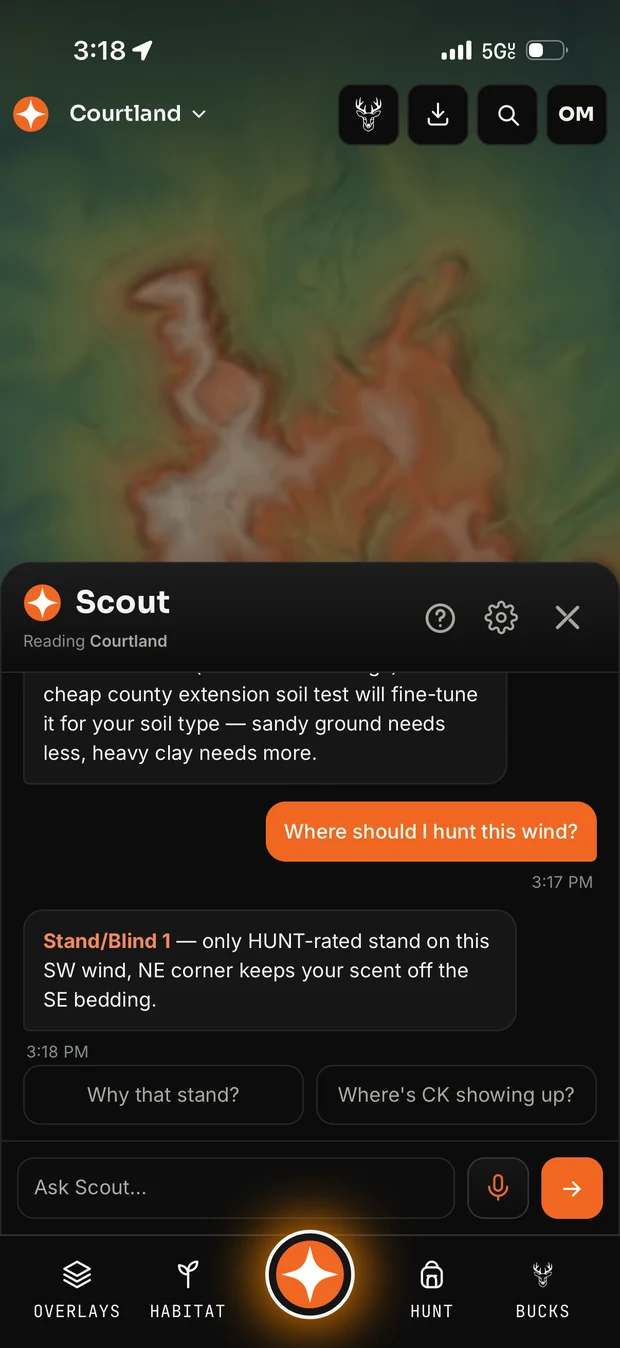
What an AI hunting assistant does is hold that same set of variables — terrain, wind, thermals, pressure, weather, season phase, your own logged sits — and reason across them in a couple of seconds. It does not know something you could never know. It considers more of what you already know, at once, without getting tired or optimistic.
Four things it does well
- Cross-referencing conditions against a specific stand. Given a northwest wind at 11 mph, a rising barometer, and the third week of October, which of your six stands is actually huntable without your scent crossing bedding?
- Reading terrain from imagery faster than you can. Saddles, benches, inside corners and pinch points are visible in contour data. Finding them across 800 acres by eye takes an evening; finding them computationally takes seconds.
- Remembering your own history. You logged eleven sits last season. Which wind directions actually produced sightings on that property? Most hunters never do that arithmetic.
- Scoring a trail camera photo without you setting up a spreadsheet or arguing with your buddies about whether he is a 140 or a 155.
The part nobody selling AI wants to say
AI cannot see deer. It has no live animal data. It does not know that a neighbour pushed a drive through the back forty on Tuesday, or that the acorns dropped early on the east ridge, unless you tell it. It is working from maps, weather, and whatever you have logged — the same inputs you have, held together better.
Any product implying otherwise is selling you something that does not exist. Deer movement is probabilistic. A good tool improves your odds and narrows your options. It does not produce certainty, and a hunter who expects certainty will be disappointed by every app on the market, including ours.
Where it changes the outcome
The real gain is decision speed on the days that matter. You get home from work at 3:40, the wind swung, and you have forty minutes to decide which stand to walk into. That is the moment where holding six variables at once is genuinely hard, and where a tool that already knows your property earns its keep.
The second gain is for hunters new to a piece of ground. E-scouting a fresh lease normally costs you a season of mistakes. Reading terrain computationally does not replace boots on the ground, but it stops you burning October learning things the contour lines could have told you in March.
Common questions
Can AI tell me where a buck is right now?
No. There is no live animal tracking data available to any consumer hunting app. AI works from terrain, weather, pressure patterns and your own logged observations — it narrows probability, it does not locate animals.
Is AI hunting cheating?
It reads public maps and weather the same way you would with more time. It does not locate animals, and it does not put you anywhere you could not legally hunt anyway. Practically it is closer to a very well-organised hunting partner than to a drone.
Do I need cell service for AI hunting features?
For the assistant, yes — it needs a connection to answer. Maps can be cached for offline use, which is the part that matters once you are actually in the timber.
What does AI need to know about my property?
Boundaries first, then stands, cameras, food and access routes. Without a map of your ground, an AI assistant can only give you generic deer hunting advice, which is worth very little.