Short answer: AI can predict deer activity with meaningful accuracy — the conditions under which movement rises — and cannot predict deer location at all. That distinction is the whole answer, and most marketing blurs it deliberately.
Why activity is predictable and location is not
Deer movement responds to measurable inputs. Barometric pressure, temperature swings relative to seasonal norms, wind speed, moon phase to a lesser degree, and above all photoperiod and rut phase. These are all things a model can consume, and decades of telemetry research has established real correlations.
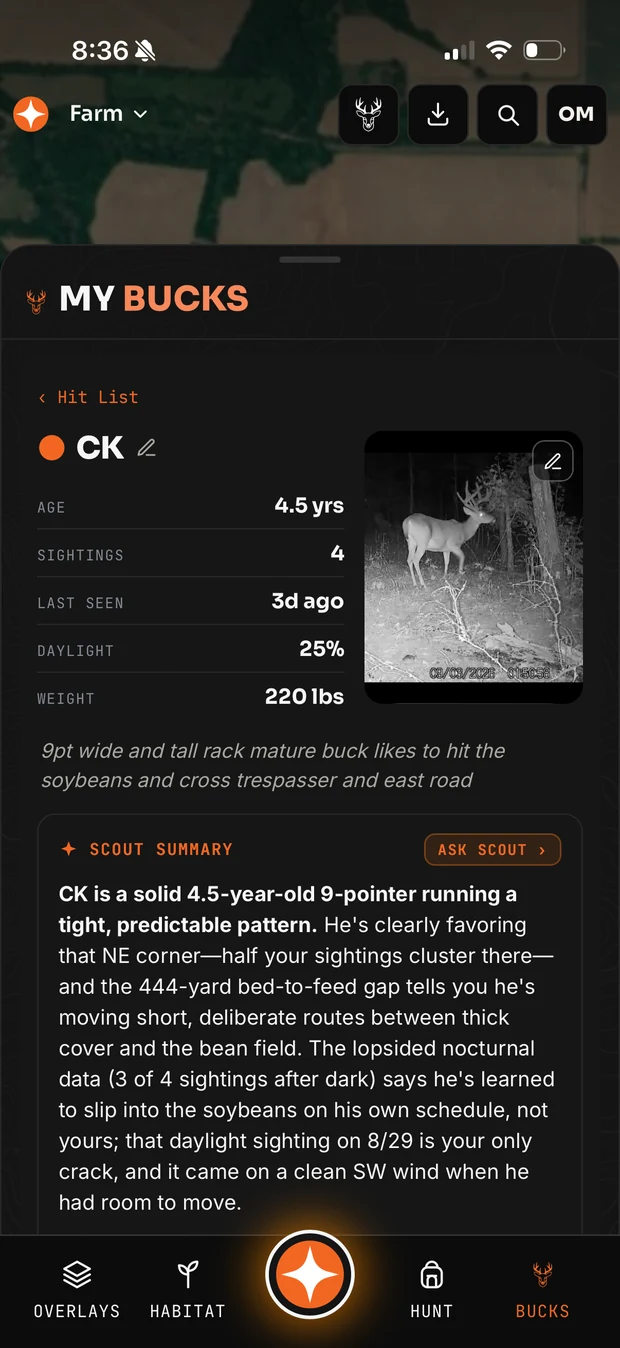
Location is different. Where a specific buck stands at 4:40pm depends on where he bedded, which is downstream of where he was pressured yesterday, which is downstream of whether the neighbour's kid rode a four-wheeler through the creek bottom. No consumer product has that data. Nothing observable from a satellite or a weather API resolves it.
What the research actually supports
- Falling pressure ahead of a front, then rising pressure behind it. The most consistently supported weather signal for daylight movement, particularly the 24 hours after a sharp front passes.
- Temperature relative to the seasonal average, not the absolute temperature. A 45-degree day in early October moves deer; a 45-degree day in late December does not.
- Rut phase. Photoperiod-driven and remarkably consistent by latitude year over year. This is the strongest predictor in the whole set.
- Wind speed. Movement tends to drop in sustained high wind, though hunters overstate how much.
Where models get oversold
Moon phase is the classic. It sells calendars and it appears in every hunting app, and the research supporting it is far weaker than the confidence with which it is presented. Treat any tool that leads with lunar prediction with suspicion.
The other oversell is precision. A model that says "movement index 87" is presenting a probability as a number, and the false precision does real damage: hunters skip good sits because a number was low. Conditions shift odds. They do not issue verdicts.
How to actually use a prediction
Use it to allocate scarce sits, not to decide whether to hunt. If you have eight hunts left in the season and a job, a model that flags the two best condition windows in the next fortnight is worth real money. If you have all week, hunt anyway — deer get killed on flat, boring days constantly.
Common questions
Can AI tell me the best day to hunt?
It can rank the coming days by the conditions most correlated with daylight movement. That is genuinely useful for planning limited sits, but a low-ranked day is not a bad day — it is a slightly lower-probability day.
Does AI use real deer location data?
No consumer hunting app has live animal location data. Anything implying it does is either using your own trail camera photos or overstating what it has.
Is a movement forecast better than a solunar table?
A forecast built on pressure, temperature anomaly and rut phase rests on far stronger evidence than a solunar table, which is largely lunar and weakly supported.