Short answer: Stand selection is the one hunting decision that is genuinely computable, because every input is knowable: where your stands are, where deer bed and feed, which way the wind blows, how thermals move on your terrain, and how you get in.
The four constraints, in order
- Can I get in without being winded or seen? Access kills more hunts than stand placement. If the route crosses the bedding side, the stand is out regardless of how good it is.
- Does my scent go somewhere harmless? Not just "is the wind right" — where does the scent cone actually land? A crosswind carrying into the feeding field is fine at dawn and ruinous at dusk.
- Do thermals override the forecast? In hill country for the first and last hour of light, they usually do. A stand that works on paper can be wrong at first light because cooling air is sliding your scent downhill into the bedding.
- Does the season phase match the setup? An October food-source stand and a November funnel stand are not interchangeable.
Why hunters get this wrong
Because they check the wind and stop. Wind direction is one of four constraints and the easiest to check, so it gets treated as the whole problem. The stand that fails is usually the one with a perfect wind and a terrible entry.
The second failure is loyalty. Every hunter has a stand they like sitting, and there is a strong pull to talk yourself into it. A tool has no favourite stand — which is genuinely useful, because it will tell you the one you like is wrong today.
What good reasoning looks like
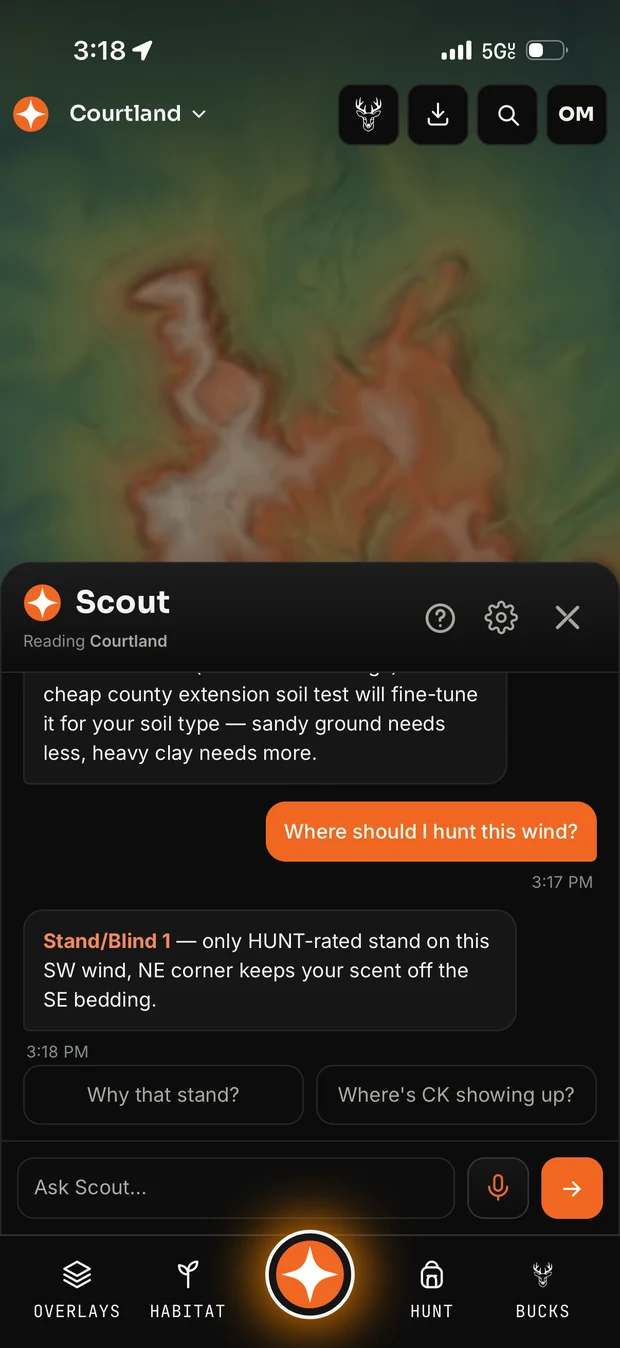
A useful answer names a stand, names the wind it is keyed to, flags the access route, and says what would change the recommendation. "North stand — the northwest wind carries your scent into the cut cornfield rather than the bedding ridge, and you can walk the creek in without crossing the trail. If the wind swings west, move to the creek stand instead."
An answer that just says "hunt a stand where the wind is in your face" is a hunting truism, not a recommendation.
Common questions
What is the most important factor in stand selection?
Access, not wind. A perfect wind cannot save a stand you have to blow out the bedding area to reach.
How do thermals change stand choice?
In hill country, thermals dominate the first and last hour. Scent rises with warming air in the morning and sinks with cooling air in the evening, which can reverse what the forecast wind implies.
Should I hunt the same stand repeatedly?
Repeated pressure on one stand teaches mature bucks to avoid it. Rotating across setups keyed to different winds keeps pressure spread and gives you an option on more days.