Short answer: Buck Score estimates a whitetail's gross score from a trail camera photo in under a minute. It is an estimate from a two-dimensional image, not a tape measure — useful for triage and comparison across a season, not for entering a buck in the book.
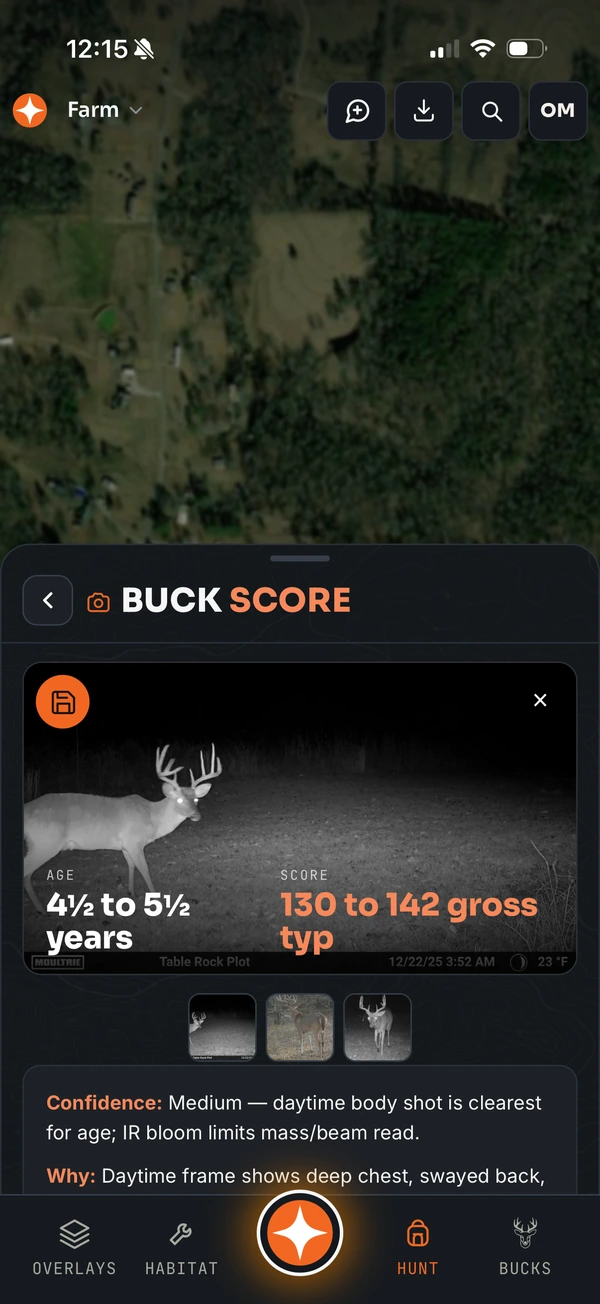
What it is for
Most hunters do not need a precise number. They need to answer three questions fast: is this the same deer I had last year, is he bigger than the one on the other camera, and is he a deer I would take on day one or hold out on. Photo scoring answers all three well enough to act on.
The other use is settling arguments. Every hunting camp has a buck that one man calls a 130 and another calls a 160. A consistent estimate applied to both photos at least puts everyone on the same scale.
How photo scoring works
A whitetail's skull gives you a built-in ruler. Ear tip to ear tip on an alert buck runs roughly 15 to 17 inches on a mature deer, and eye to nose is roughly 7 to 8 inches. Once you have a known reference in the frame, beam length, tine length and inside spread can be estimated proportionally.
That is the same method an experienced hunter uses by eye. The difference is consistency: a person's estimate drifts with excitement, lighting and how badly they want the deer to be big. A measurement from fixed reference points does not.
Where it goes wrong
- Bad angles. A deer quartering hard away compresses the rack in the frame and will read low. Straight-on or broadside alert shots are worth far more than a pile of bad ones.
- Night photos with blown highlights. If the flash washes out tine tips, they cannot be measured. Infrared images with visible antler edges score far better than white-flash images with hot spots.
- Young bucks with tall ears. The ear-width reference assumes a mature deer's skull. A yearling's proportions differ, and estimates on young deer skew high.
- Mass. Circumference measurements are the hardest thing to judge from any photo, by a person or otherwise. Expect this to be the weakest part of any estimate.
Getting a usable photo
Set cameras at a height where a standing deer is broadside in the frame rather than looming over the lens. Cameras aimed slightly down a trail at 20 to 30 feet produce better scoreable images than cameras jammed on a trail at ten. And keep the ones where he is looking at the camera — an alert, forward-eared buck is the single best scoreable image you will get.
Common questions
How accurate is scoring a buck from a photo?
For a good broadside or straight-on photo of a mature deer, expect an estimate within roughly ten inches of gross. Bad angles, night flash blowout and young deer widen that considerably.
Can it tell a buck's age?
Age estimation from photos is far less reliable than score estimation. Body characteristics — chest depth, belly line, neck and brisket — matter more than antlers, and they vary by region and nutrition.
Does it work on mule deer or elk?
The reference proportions here are built for whitetail skulls. Other species need different reference measurements and will read incorrectly.
Do I need a specific camera brand?
No. Any photo works. Image quality matters far more than brand — a clear image from a cheap camera beats a dark, blurred image from an expensive one.