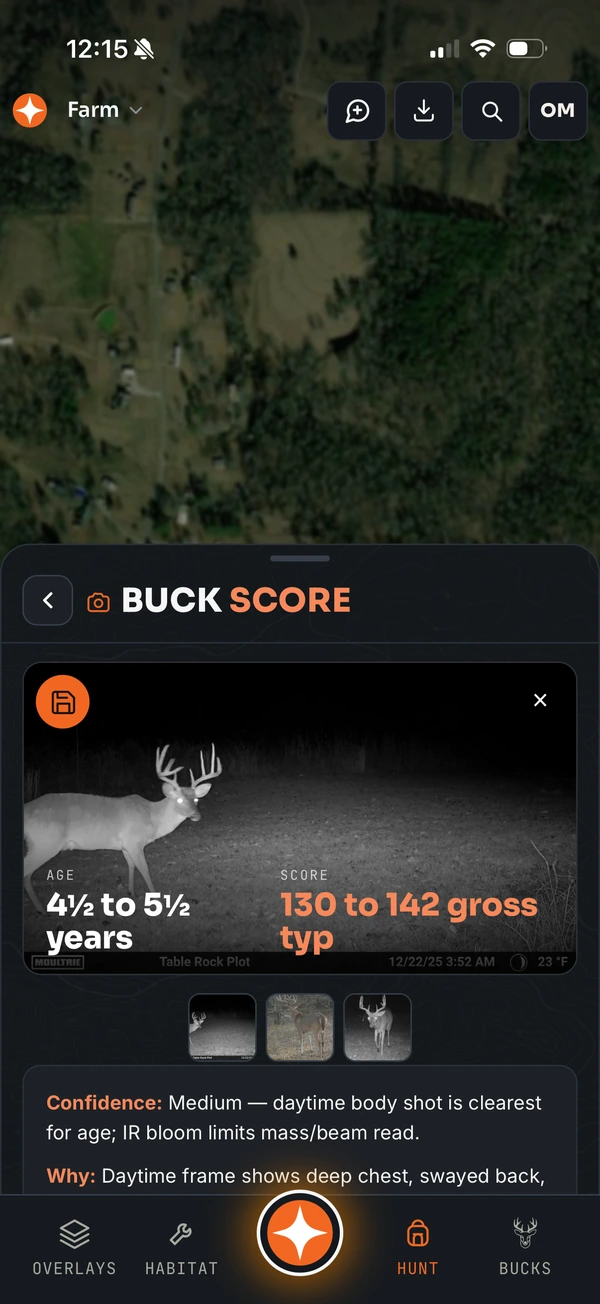
Short answer: Photo scoring works because a whitetail's skull is a ruler that comes attached to the antlers. Ear spread and facial proportions are consistent enough on mature deer to serve as a reference, and everything else is measured against them.
The reference measurements
- Ear tip to ear tip, alert: roughly 15 to 17 inches on a mature whitetail buck. The single most useful reference in any photo.
- Ear length: roughly 6 to 7 inches, useful when only one ear is clean in frame.
- Eye to nose: roughly 7 to 8 inches, and the best fallback when the ears are laid back.
- Eye width: around 1.5 inches, used for estimating mass where the beam passes near the eye.
Given any one of these in frame, beam length, tine length and inside spread follow proportionally. It is exactly what an experienced hunter does by eye — the software just does not get excited.
Why the same buck scores differently in two photos
Angle, mostly. A deer quartering away compresses the rack in the frame; the same buck straight-on reads considerably wider. Lens distortion at the frame edge adds error, and a deer close to a wide-angle trail camera lens gets stretched.
Alertness matters too. A relaxed deer with ears at half-mast gives a narrower ear reference than an alert one, which throws every proportional measurement that depends on it. The best scoreable photo is a buck who has just heard the camera click and is staring straight at it.
Camera setup for better estimates
- Mount at deer chest height, not high and angled down. Overhead angles compress everything.
- Set the camera 20 to 30 feet off the trail rather than right on it, so deer appear whole in frame.
- Face north where you can, so sunrise and sunset do not wash out the image.
- Prefer low-glow infrared over white flash. Blown-out tine tips cannot be measured by anything.
What it will never tell you
Age reliably. Body characteristics carry far more age signal than antlers, and they vary enormously by region and nutrition — a three-year-old in Iowa farm country can outweigh a five-year-old on poor southern ground.
And mass will always be the weakest part of any estimate. Circumference is genuinely hard to judge from a two-dimensional image, for software and for people.
Common questions
How accurate is AI buck scoring?
On a clean broadside or straight-on photo of a mature deer, within roughly ten inches of gross. Poor angles and night flash blowout widen that considerably.
Why did the same deer score differently on two cameras?
Almost always angle and alertness. A quartering deer reads narrow, and a relaxed deer with lowered ears throws the primary reference measurement.
Can it distinguish individual bucks?
Antler configuration is distinctive enough that hunters do this by eye routinely. Software helps most with side-by-side comparison across cameras and seasons.