
Short answer: New ground with no history is the situation where mapping pays for itself fastest. Work it in this order and you will arrive in October knowing more than a hunter who has walked it aimlessly since spring.
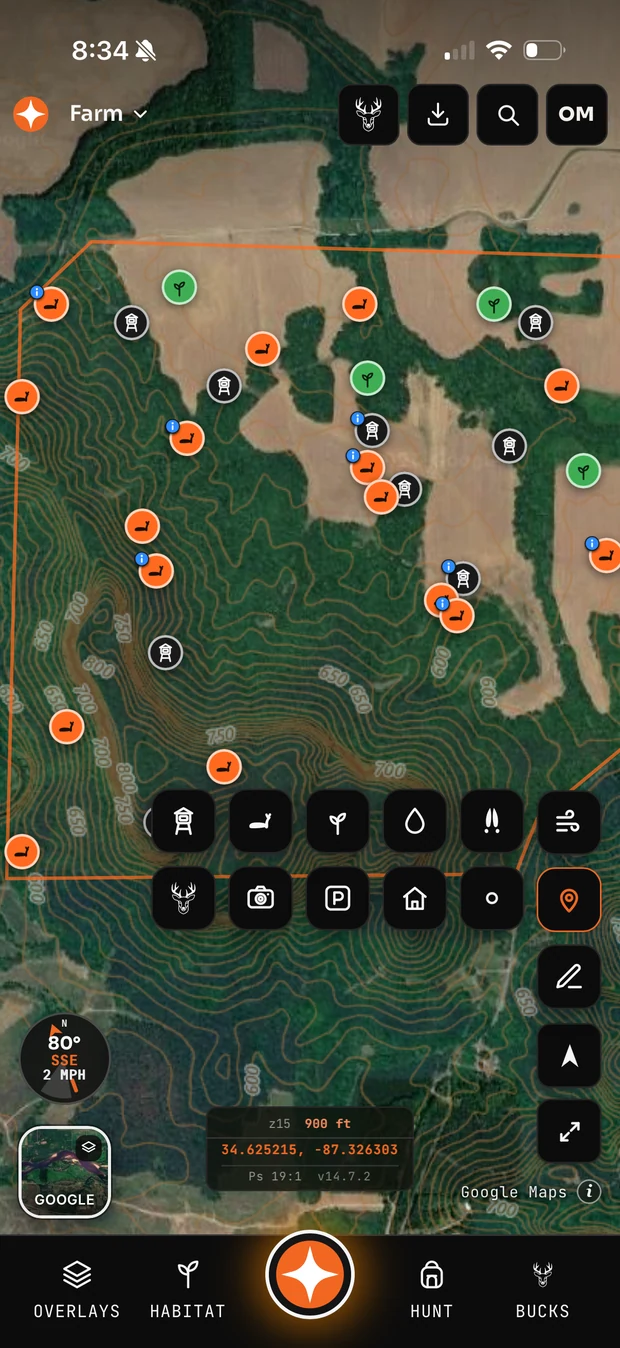
Before you set foot on it
- Draw the exact boundary. Then verify the corners against county parcel records. Lease descriptions are frequently vague and neighbours are frequently certain.
- Find the terrain features. Every saddle, bench, drainage and pinch. Mark them all, even the ones you doubt.
- Identify the food. Fields, mast-producing timber, and anything agricultural on the neighbours that will pull deer off your ground.
- Map the pressure. Where do the roads run, where would another hunter park, where does the neighbour's stand look onto your line?
- Plan three access routes for three different wind directions, before you have stands to reach.
The first walk
Go in late winter if you possibly can. Leaf-off, sign still visible from the season just past, and nothing you do costs you a hunt. Walk the terrain features you marked and correct the map as you go — you will be wrong about a third of them, and that correction is the whole point.
Look for the things imagery cannot show: browse lines, rub lines and their direction, actual cover density, blowdowns, and where the ground is wet enough to hold tracks.
What to leave alone
Once you have found probable bedding, stay out of it. The temptation to confirm is enormous and the cost is real — a bedding area you walk in August is a bedding area that may be abandoned by October.
Mark it, believe it, and hunt the edges. You do not need to see the beds to know they are there.
Setting stands
Hang fewer than you want to, keyed to different winds rather than different spots. Three stands covering three winds beats six stands that all need a north wind, because the wind will not cooperate and you will end up hunting the wrong one.
Common questions
When should I scout a new lease?
Late winter is ideal — leaf-off visibility, last season's sign still readable, and no cost to the coming season from disturbance.
How many stands should I hang on new ground?
Fewer than you want. Three well-placed sets covering different wind directions beat six that all need the same wind.
Should I walk the bedding areas?
Once, in late winter, if at all. After that stay out. Confirming bedding in early autumn frequently costs you the bedding.